

[thrive_custom_box title=”” style=”dark” type=”color” color=”#fef5c4″ border=”fadf98″]
Important: I use New York close charts so that each 24-hour period closes at 5 pm EST.
Click here to get access to the same style charts I use on this website.
[/thrive_custom_box]
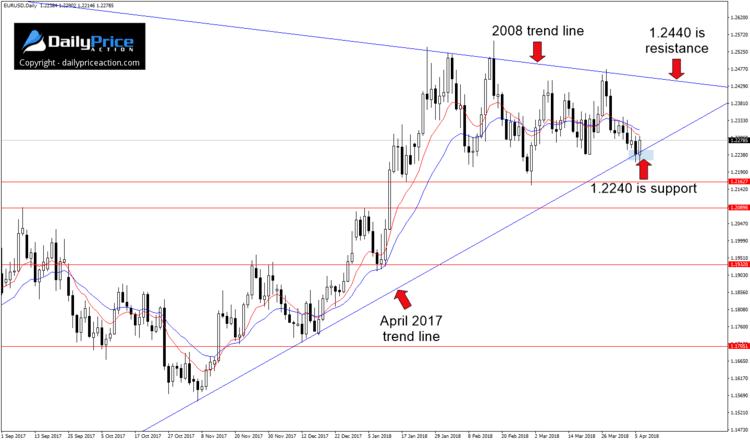
The EURUSD did something last week it hasn’t done since December 18. The trend line that extends from the April 2017 low has now been tested on two separate occasions after forming on November 7 of last year, with the most recent being Thursday and Friday of last week.
Buyers were able to hold prices above the level on a daily closing basis last week, which means the support level is still very much intact.
However, as I’ve mentioned for several weeks now, I’m not interested in trading this consolidation. I’m much more interested in a break below the April 2017 trend line or above the 2008 level shown in the chart below.
As long as trend line support near 1.2240/50 holds on a daily closing basis, the 2008 trend line remains exposed. At the moment that level comes in near 1.2440.
Alternatively, a close below 1.2240 would expose 1.2160 followed by 1.2090. However, if the EURUSD does break trend line support over the coming sessions, I’m anticipating a move to 1.1930 and perhaps even 1.1700.
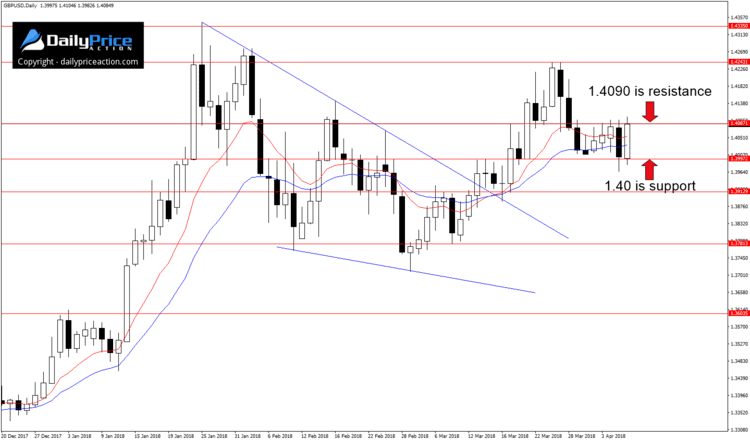
Last week’s price action on the GBPUSD is the perfect example of why I haven’t been very active lately. The pair spent the entirety of last week trading in a 90 pip range, which doesn’t leave much room for favorable entries.
Moreover, the pair has been directionless since topping out in late January. There have been a couple of opportunities since then, but overall it’s been a tug-of-war match between buyers and sellers.
If the GBPUSD can manage a daily close (using a New York close chart) above 1.4090 this week, we could see a move to the March high at 1.4240. Alternatively, a daily close below 1.40 would expose the 1.3910 area.
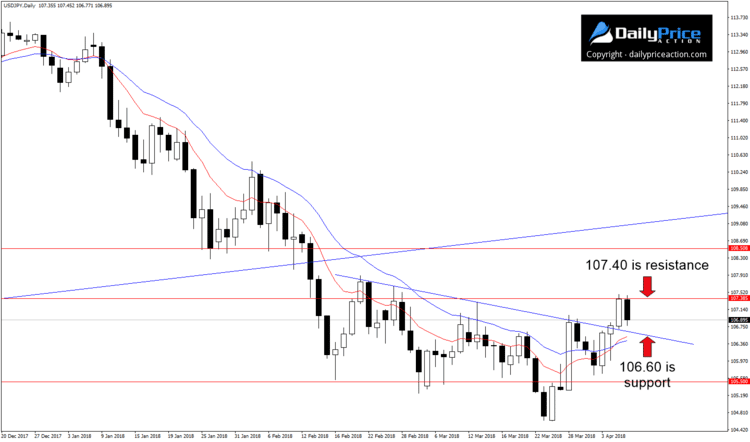
The USDJPY gained additional ground last week after closing above the short-term trend line from the February 21 highs.
However, not long after the pair encountered selling pressure at 107.40. The weakness carried over into Friday’s session, yet the pair managed to stay above the short-term trend line support near 106.60.
I do think we could see some additional upside here, but I’m not interested in selling the yen. Based on what I see with other yen pairs and risk assets as a whole, I can’t get behind the idea of an extended risk-off move.
Of course, it doesn’t mean the USDJPY can’t trend higher from current levels. As long as the pair trades above the 106.60 area, that’s a distinct possibility. However, it’s going to take a daily close above last week’s high near 107.40 to open up the next key resistance at 108.50.
[thrive_custom_box title=”” style=”dark” type=”color” color=”#fef5c4″ border=”fadf98″]
Free Webinar: Learn how I trade pin bars, draw key levels, and much more!
[/thrive_custom_box]
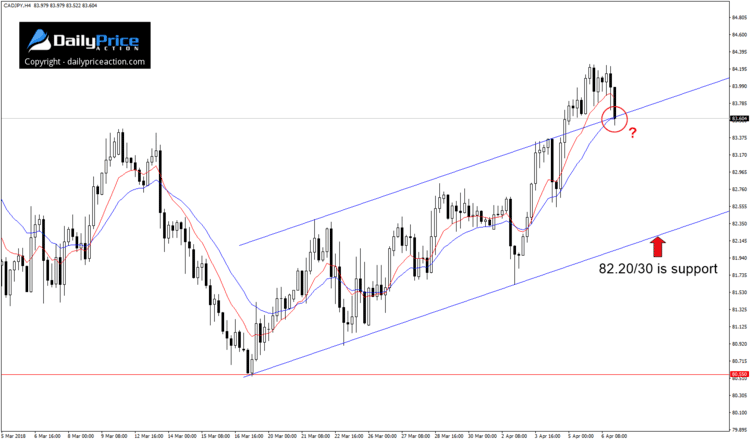
On April 4 I pointed out an ascending channel that had formed on the CADJPY 4-hour chart. At the time, the pair was trading just below resistance at 83.40.
However, just a few hours later the pair closed above ascending channel resistance.
It wasn’t a buying opportunity as one of my rules when trading channels is to never buy an upside break of an ascending pattern. The same holds true for selling a downside break of a descending pattern.
The final hours of Friday’s session were a prime example of why I avoid these situations. In many cases, an upside break like this one on the CADJPY can produce a selling opportunity following a close back inside of the channel.
I’m not convinced that has occurred just yet. The final print on Friday was close, but I’ll wait to see how the next few 4-hour candles play out before making a decision.
If sellers do manage a close back below the upper boundary, we could see the CADJPY slide lower this week toward 82.20/30. Otherwise, additional gains are likely, though I won’t be interested if that’s the case.
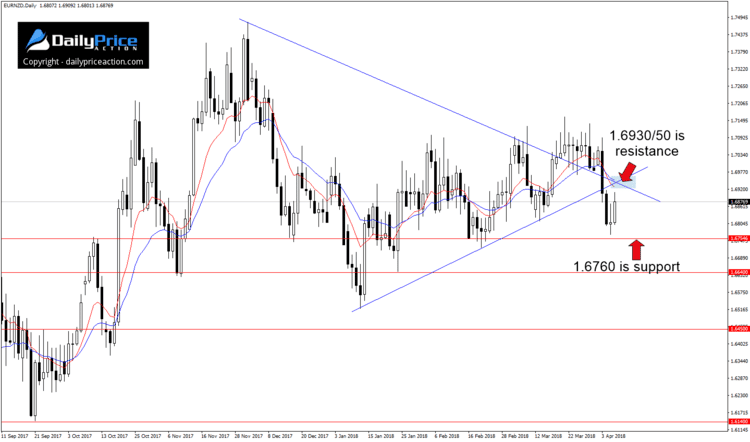
On April 3 I mentioned the EURNZD as it was about to close below a key area near 1.6925. The 1.6905 close later that day paved the way for the pair to move lower toward the next key support near 1.6760.
Those interested in selling last week’s break never got a retest of former support at 1.6925. However, judging by Friday’s rally, we may get a retest of the confluence of resistance at 1.6930/50 before the next leg lower begins.
For a less liquid cross like the EURNZD, I’m going to require bearish price action from the 1.6930/50 area before considering a short entry. Key support for the week ahead comes in at 1.6760 followed by 1.6640.
[thrive_custom_box title=”” style=”dark” type=”color” color=”#fef5c4″ border=”fadf98″]
Important: I use New York close charts so that each 24-hour period closes at 5 pm EST.
Click here to get access to the same style charts I use on this website.
[/thrive_custom_box]

Thank you Sir
Why did you leave GBPJPY out this week?
Are your previous ideas invalidated at this point?
The lower level on the GBPJPY that I’ve been watching? Yes.
The upper level that extends from the 2016 low? No.
What are your thoughts about GBPJPY. It appears to have reached your expectations. Thanks
I might post about it later this week.
Thank’s a lot, Justin
Hi Justin,
What additional resistance levels do you see in case eurusd moves north till 1.2440? Thanks.
Hi Dan, I’ll discuss if and when it happens.
Grazie!
My major focus GBPUSD, below 1.40 would 1.3910 area. All the best.
Hi Justin i just want to say thanks for the informstion you provide it really helps keep up the good work
God Bless
Hello Justin, you’ve said you observe about 20 currency pairs. Could you please list all of them? I also trade on D1 time frame so I’d like to check these instruments.
You often speak about a daily close. How exactly do I confirm the price at which a pair closes on any particular day?
The daily close Justin refers to happens at 5pm EST, which is New York time, which is GMT-5. On Daily and 4hr charts, this is when the forex trading day is deemed to begin and end.
Justin as i have realised you are price action trader, naked chat, what are these MAs do on your chats? Can’t you do without them? Price action plus indicators don’t add up the way i was following you, please clarify
Hi Erry, I dont think you have read all of the articles posted by Justin. Those MA’s just for references only, as justified by Justin, it is only to see the means between EMA10 & EMA20. If you said you have been following him, please read all of his articles. Cheers!
I use them as a mean reversion tool. See here:
https://dailypriceaction.com/free-forex-trading-lessons/mean-reversion-guide-to-market-timing
Thanks Sir.
Hi Justin,
Just wondered what do you think of the pinbar on GBP CAD weekly chart?
Hi Justin
could u pls provide me wiz ur email ?
hit thanx justin what are your moving avarage defaults ( settings ?
EMA 10 & EMA 20. But those EMA is not a entry signal. We trade purely based on price action here. Cheers!
Hi Justin, would like your view on CHF/JPY if the pair has
bottomed or still have more downside to go.
hi justin, can i sell CADJPY ?
Why should you sell it Medy? Any analysis made before any entry is suicide LOL
medy, please do your reasearch on this pair. make sure to read all the material on this site and try to get a trading edge in the markets and then you will be able to tell if you should sell this pair.
Hi Justin
Why do you never trade upward breakouts in an ascending channel or downward breakouts in an ascending channel?…thanks John F (UK)
John, I do trade downward breakouts of ascending channels. I don’t, however, trade upward breakouts of ascending channels.
The reason is that it’s considered a “weak” breakout. The ascending channel is consolidation that usually forms within a downtrend, thus I only want to be a seller.
Thanks Justin for sharing your trade ideas with us. God bless you.
Hola justin bennett
Buenos dias
Escribir programas forex
Todos saludo
Jabir laasri
pls how do I get your trading signals?
Hi Justin,
Excellent analysis for the USD/JPY !
106.50 is where I have my SL and my analysis is exactly the same as yours for R levels.
Chaidaen